Assyrians
The empire that destroyed the northern kingdom of Israel and threatened Judah.
What the sources say, and how sure we are
- The text says
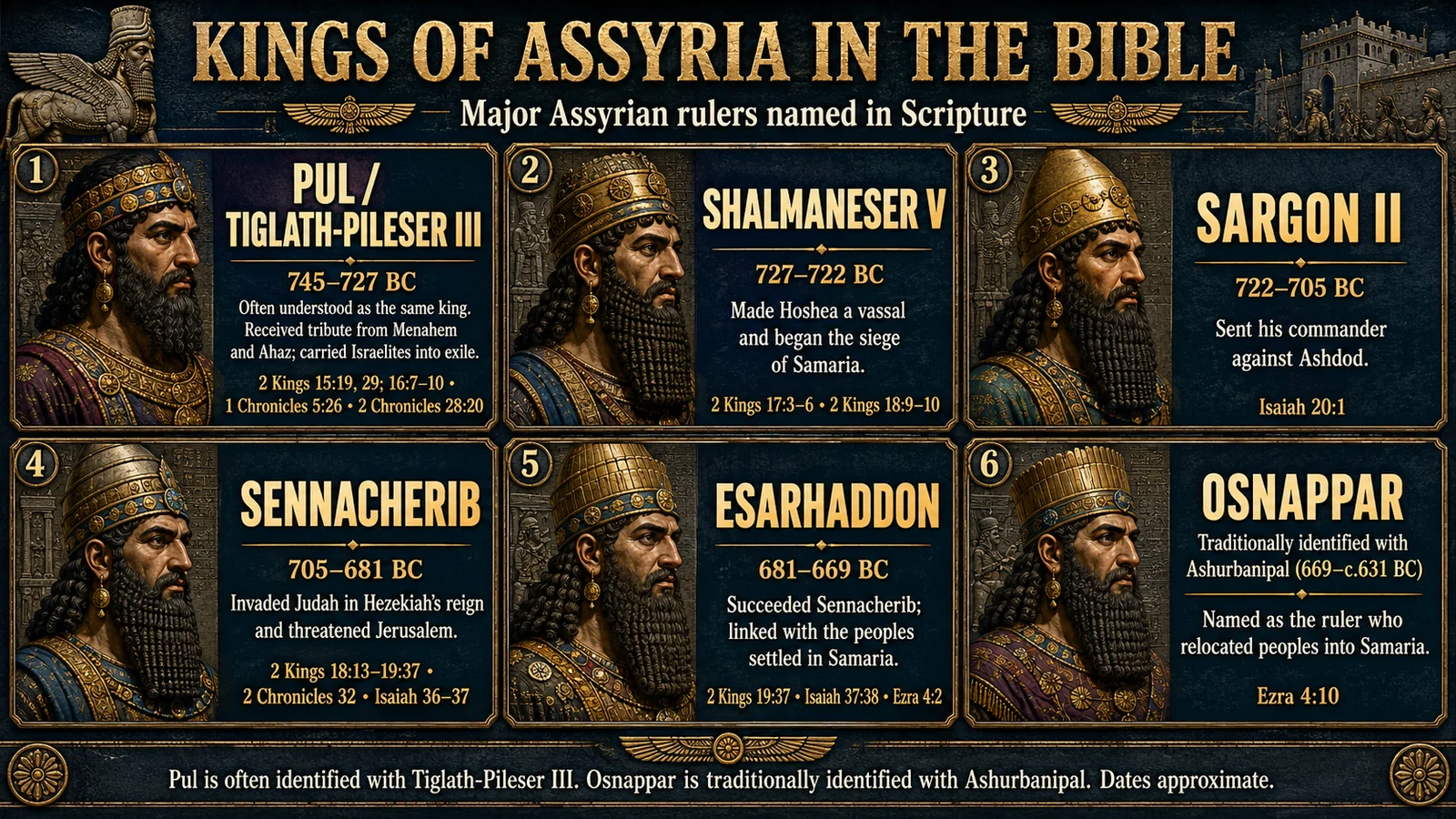
Assyria takes tribute from Israel and Judah, takes Samaria and carries Israel away, and besieges Jerusalem in 701 BC. Isaiah calls Assyria the rod of God’s anger, and Nahum announces the fall of Nineveh.2 Kgs 15:19; 2 Kgs 17:5–6; 2 Kgs 18–19; Isa 10:5; Nah 3
- Outside evidence
Assyrian records name Menahem, Jehu, Ahab, and Hezekiah. Sennacherib’s Prism describes shutting Hezekiah in Jerusalem “like a bird in a cage.” Reliefs from Nineveh show the siege of Lachish, and the Babylonian Chronicle records Nineveh’s fall in 612 BC.Black Obelisk; Sennacherib Prism; Lachish reliefs; Fall of Nineveh Chronicle (ABC 3)
- Debated
Samaria fell about 722–720 BC. The Bible and a Babylonian chronicle point to King Shalmaneser V, who besieged it. Sargon II’s own records claim the city and the deportation of 27,290 people. Most scholars think Shalmaneser took the city and Sargon finished the job; a few think it fell once.2 Kgs 17:3–6; 2 Kgs 18:9–10; Babylonian Chronicle 1; Sargon II, Khorsabad Annals
- Debated
Some scholars hold that Sennacherib made one campaign against Judah in 701 BC, and others that he made two. They also differ on how to read the outcome of the siege, since the Bible and Sennacherib’s own account differ.2 Kgs 18:13–19:37
- Christian conclusion
Christians read Isaiah’s words about Assyria as showing that God rules the nations, even those who do not know him.Isa 10:5–15