Key texts
The biblical passages that establish the era.
Follow the major movements of Scripture in sequence and see how each era prepares for what comes next.
The timeline is the backbone of Bible Building Blocks. It gives every person, place, kingdom, promise, and biblical book a position within the larger story.
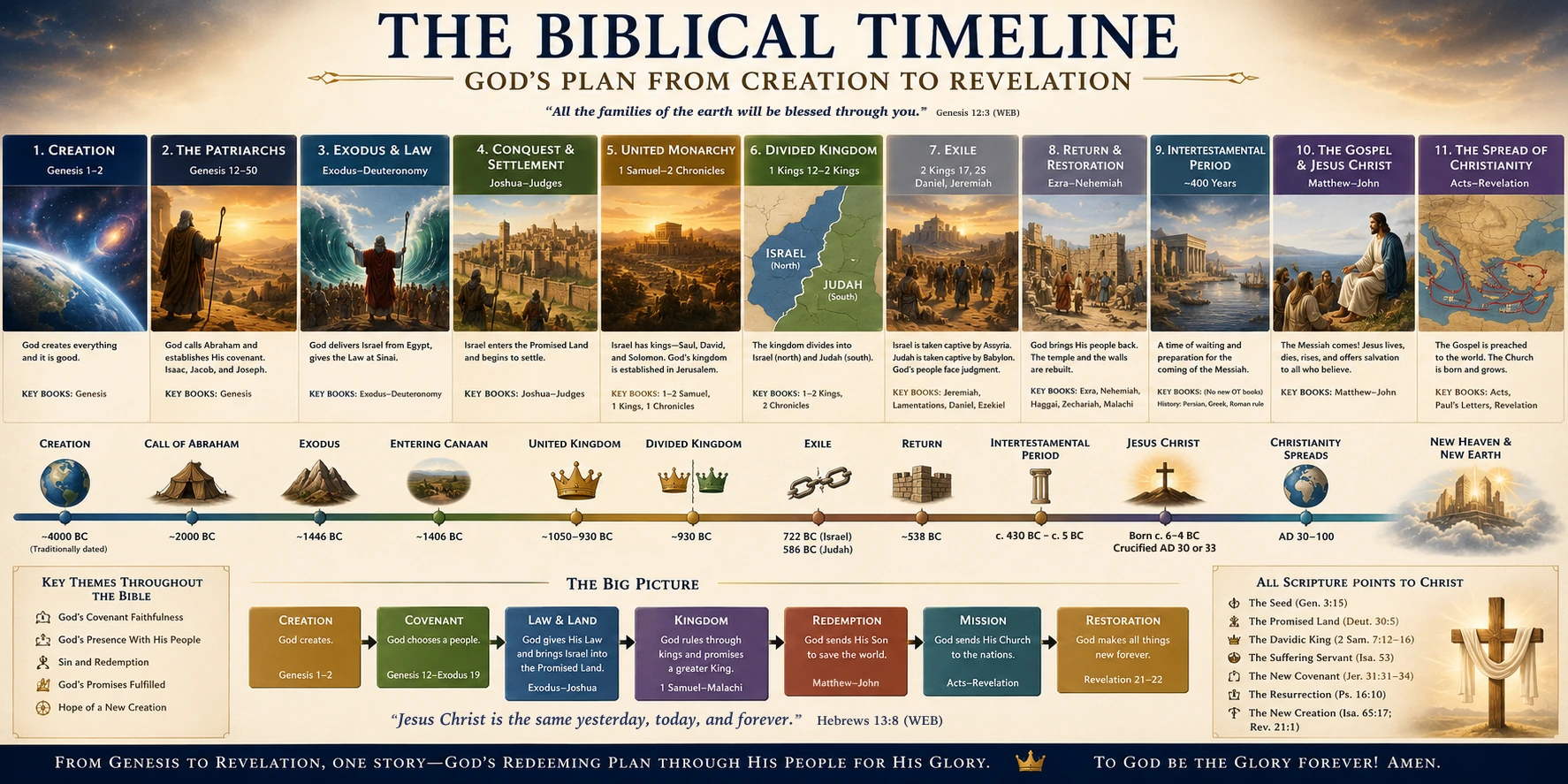
The chart below shows all eleven eras at a glance. Each era page brings together its key texts, dates, places, people, and connections to the larger story.
Illustration. Dates are approximate and debated. Click an era to open its page.
The Creation date on the chart (about 4000 BC) is a traditional estimate; the Bible itself does not date creation. The Exodus date shown (about 1446 BC) is one of two main views; many scholars hold about 1260 BC. Book ranges on the chart (such as Genesis 1–2) are summaries; each era page gives the full range.
On a phone the chart is small. Use the era cards below, or view it full size.
Which empire ruled over the land of Israel in each era. The strip shows who held the stage over the land, not who was biggest in the world.
No datable empire
Egypt (in the background)
Egypt (Exodus about 1446 BC or about 1270–1250 BC)
Egypt, fading (to about 1150 BC) → No empire (after about 1150 BC)
No empire
Before Assyria (931–853 BC; Egypt’s Shishak raided about 925 BC) → Assyria (853–609 BC: contact from 853, empire ends 612, remnant to 609) → Egypt (609–605 BC: Necho holds Judah) → Babylon (from 605 BC)
Babylon (to 539 BC) → Persia (from 539 BC)
Persia (539/538–332 BC)
Persia (to 332 BC) → Greeks (332 to 164/142 BC: Alexander, the Ptolemies, then the Seleucids) → Hasmoneans (164/142–63 BC) → Rome (from 63 BC)
Rome
Rome
Each era gets an equal column, as in the era list. Inside an era, widths follow the dates; a small triangle marks a handoff in the middle of an era. Era 4 uses the early-date framework. Hatched spans: no empire is named on the stage. The hatched “Before Assyria” span in era 6 (931–853 BC) is a drawing aid: our source table names no empire there, and Assyrian contact begins in 853 BC. The Hasmonean span is labeled 164/142 because sources differ on its start; the strip draws it from 142 BC.
These are navigation categories, not claims that every event can be assigned an uncontested date.
Creation, human rebellion, judgment, and the preservation of God’s purpose for humanity.
Abraham, Isaac, Jacob, Joseph, and the covenant family through whom blessing is promised.
Israel’s deliverance from Egypt, the covenant and law given at Sinai, and the formation of a people.
Israel’s entry into Canaan, settlement, repeated disorder, deliverance, and need for faithful leadership.
Samuel, Saul, David, Solomon, Jerusalem, the temple, and the promise of a lasting dynasty.
Israel and Judah, their kings and prophets, Assyrian pressure, and the northern kingdom’s fall.
Jerusalem’s fall to Babylon, the destruction of the temple, and life in exile under foreign empires.
The return from exile under Persia, rebuilding the temple and Jerusalem’s walls, and the last Old Testament prophets.
The years between the last Old Testament prophet and the birth of Jesus: Persian, Greek, Hasmonean, and Roman rule. A short outline page.
The world of Jesus, his ministry, death, resurrection, and the Christian claim that Israel’s story reaches its center in him.
Pentecost, the apostles, Paul, the spread of the gospel, persecution, and the formation of Christian communities. The era closes with Revelation’s vision of a new heaven and a new earth.
Reading each era the same way makes the connections between them easier to see.
The biblical passages that establish the era.
Dates, sequence, and areas of chronological debate.
Lands, cities, routes, terrain, and neighboring powers.
Individuals, families, nations, empires, and communities.
How the era receives earlier themes and prepares for what follows.
Downloadable timelines are available now.