The Spread of Christianity
Pentecost, the apostles, Paul, the spread of the gospel, the formation of Christian communities, and the Bible’s closing vision of a new heaven and a new earth.
Empire in this era: Rome still ruled, and its emperors, governors and client kings fill the book of Acts.
On the strip: Rome. The strip shows who held the stage over the land of Israel, not who was biggest in the world.
What the sources say, and how sure we are
- The text says
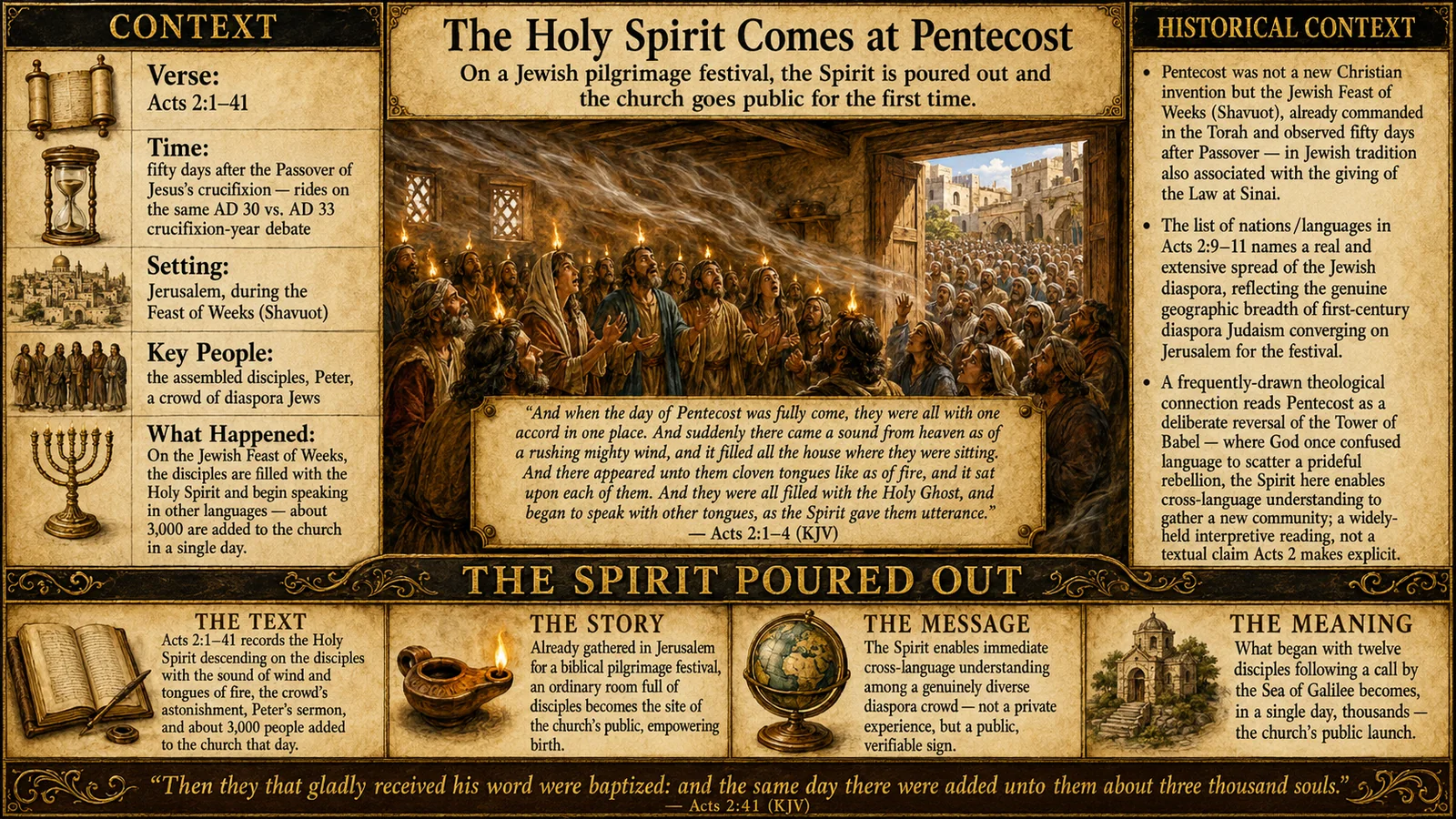
Acts tells of the gift of the Spirit at Pentecost, the growth of the church in Jerusalem, the conversion of Paul, the first Gentile believers, and Paul’s journeys across Asia Minor and Greece to Rome.Acts 2; Acts 9; Acts 10; Acts 13–28
- Outside evidence
The Gallio inscription fixes Paul’s time in Corinth to about AD 50–52. Tacitus reports Nero’s punishment of Christians in Rome in AD 64, and Pliny’s letter about AD 112 shows Christians in Bithynia being tried. Rome destroyed Jerusalem and its temple in AD 70, as shown on the Arch of Titus.Gallio Inscription; Tacitus, Annals 15.44; Pliny, Letters 10.96; Arch of Titus
- Debated
Before AD 250, Christians were punished at times and in places, by governors and mobs, but there was no empire-wide order. That changed under Emperor Decius, who ordered every person in the empire to sacrifice to the gods and get a signed certificate. The order named no group, but Christians who refused were arrested or killed. Historians still debate how much Decius had Christians in mind. Scholars also debate the dates of several letters and the order of events in Acts and Paul’s own letters.Eusebius, Church History 6.39–41; Cyprian, On the Lapsed 8; Decian sacrifice certificate (libellus), Berlin SB I 5943; Rives, “The Decree of Decius and the Religion of Empire,” Journal of Roman Studies 89 (1999); Acts 15; Gal 1–2
- Christian conclusion
Christians read this era as the spread of the gospel from Israel to all nations.Acts 1:8; Matt 28:19
New Heaven & New Earth
Revelation, written about AD 95 (or 68–70; the date is debated), is the Bible’s final vision of judgment, faithful endurance, Christ’s victory, and the renewal of creation.
- The text says
Revelation is addressed to seven churches in Asia Minor and pictures Christ’s victory over evil, the final judgment, and a new heaven and new earth in which God lives with his people.Rev 1:4; Rev 19–22
- Debated
Christians read Revelation in several ways: as events of John’s own time, as the course of church history, as events still to come, or as symbols of a conflict in every age. They also differ on the thousand-year reign in chapter 20.Rev 20:1–6
- Christian conclusion
Christians read the closing chapters as returning to the paradise of Genesis, completing the story the Bible begins.Rev 21–22; Gen 1–3