Romans
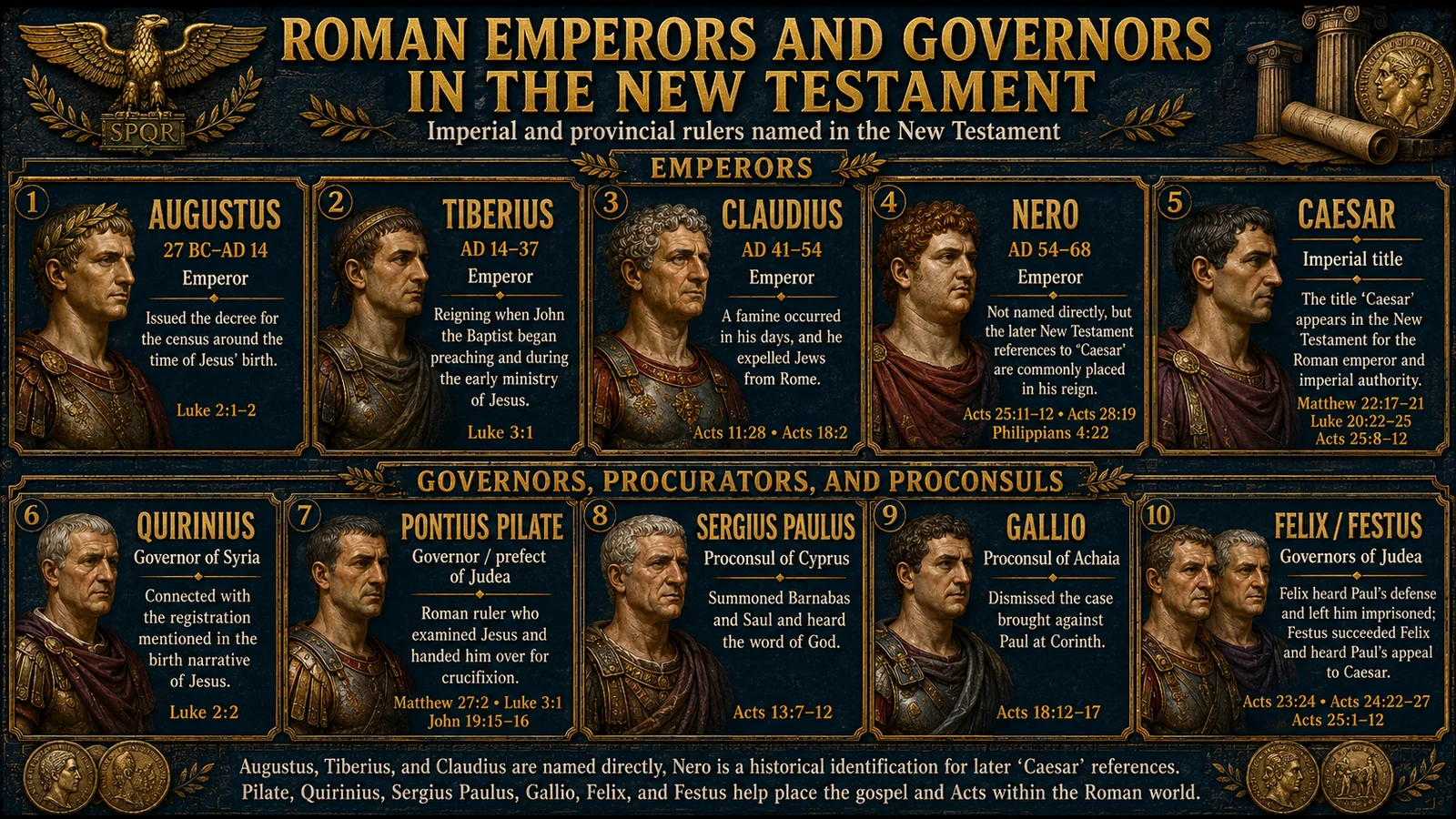
The rulers of Judea and the Mediterranean world in the time of Jesus and the early church.
What the sources say, and how sure we are
- The text says
Luke places Jesus’ birth and ministry under Augustus and Tiberius. Pilate sentences Jesus to crucifixion, and Paul appeals to Caesar and is taken to Rome. Paul writes that rulers are God’s servants, while Revelation pictures the beast of empire demanding worship.Luke 2:1; Luke 3:1; John 19:12–16; Acts 25:11; Rom 13:1–7; Rev 13
- Outside evidence
Pompey captured Jerusalem in 63 BC. Herod the Great ruled as Rome’s king from 37 to 4 BC, and prefects such as Pontius Pilate governed Judea after AD 6. Rome destroyed Jerusalem and its temple in AD 70, as shown on the Arch of Titus.Josephus, Antiquities 14–20; Pilate Stone; Arch of Titus
- Debated
Before AD 250, Christians were punished at times and in places, by governors and mobs, but there was no empire-wide order. That changed under Emperor Decius, who ordered every person in the empire to sacrifice to the gods and get a signed certificate. The order named no group, but Christians who refused were arrested or killed. Historians still debate how much Decius had Christians in mind. Scholars also debate how far the Gospels and Revelation reflect hostility to Rome, and how to read Romans 13 and Revelation 13 together.Pliny, Letters 10.96–97; Eusebius, Church History 6.39–41; Cyprian, On the Lapsed 8; Decian sacrifice certificate (libellus), Berlin SB I 5943; Rives, “The Decree of Decius and the Religion of Empire,” Journal of Roman Studies 89 (1999); Rom 13; Rev 13