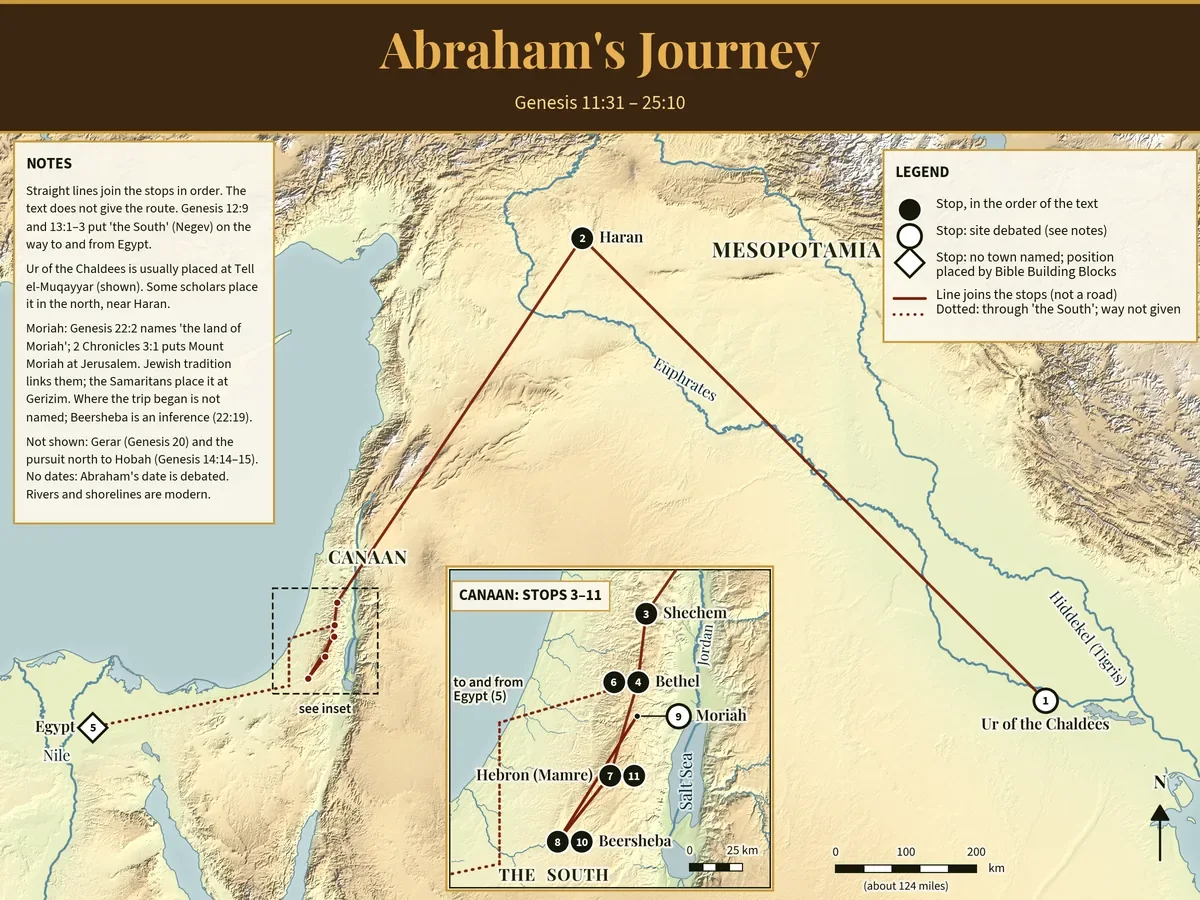
Straight lines join the stops in the order of Genesis. The text does not give the route.
Ur is shown at its usual site, Tell el-Muqayyar; some scholars place it in the north, near Haran. Moriah is linked to Jerusalem by 2 Chronicles 3:1 and by Jewish tradition.
The text names no town in Egypt, so that point is ours. Gerar and the chase north to Hobah are not shown.
Built by Bible Building Blocks from public-domain and open data: elevation from the US Geological Survey, coastlines and rivers from Natural Earth, and town points from Wikidata. Names follow the World English Bible, each checked against its verse. Shorelines are modern.
What the sources say, and how sure we are
The text says
God calls Abram to leave his country with the promise of a land, a nation, and blessing for all families of the earth. His family travels from Ur to Haran, then into Canaan (Shechem, Bethel, the Negev), to Egypt in a famine, and back to Canaan.Gen 11:31; Gen 12:1–13:4
Outside evidence
Haran was a real city in northern Mesopotamia and is named in ancient records, including letters from the city of Mari from the 1700s BC.
Debated
“Ur of the Chaldees” is usually identified with Tell el-Muqayyar in southern Iraq. A few scholars propose a northern location, and the name Chaldeans is better known from later centuries.Gen 11:28; Gen 11:31
Debated
Dates for Abraham are approximate. The Bible’s own numbers give a range that depends on how the Exodus is dated, and scholars place the patriarchs from about 2100 BC to well after 1700 BC.
Christian conclusion
Paul reads the promise to Abraham as fulfilled in Christ and extended to all nations.Gal 3:8; Gal 3:16; Gal 3:29
Why it matters
The journey sets up the whole Bible: God promises blessing through one family for all nations (Gen 12:3), and the rest of the story shows how that promise unfolds.