Intertestamental Period
The roughly four hundred years between Malachi and Matthew, when Judea passed from Persia to Greece, won its independence under the Maccabees, and fell to Rome. These are the years that built the world Jesus walked into: Herod’s temple, the Pharisees and Sadducees, a Greek Bible, and a people waiting for God to act.
Empire in this era: Persia gave way to Alexander in 332 BC, then to the Ptolemies of Egypt and the Seleucids of Syria, then to a free Hasmonean state, and finally to Rome in 63 BC; none of the Greek rulers is named in the 66 books.
On the strip: Persia (to 332 BC) → Greeks (332 to 164/142 BC: Alexander, the Ptolemies, then the Seleucids) → Hasmoneans (164/142–63 BC) → Rome (from 63 BC). The Hasmonean start is dated 164, 142 or 141 BC by different sources; the strip draws it at 142. The strip shows who held the stage over the land of Israel, not who was biggest in the world.
What the sources say, and how sure we are
- The text says
The Old Testament ends with Persia in charge. Malachi speaks to a rebuilt temple and its priests, and closes by promising a messenger to prepare the way and the return of “Elijah the prophet.”Mal 1:6–8; Mal 3:1; Mal 4:5–6
- The text says
Daniel places itself in the exile, in the 500s BC. Its vision of a ram and a goat names “the king of Greece” and says four kingdoms will rise from his. Readers on both sides of the dating question identify the first king with Alexander. That identification is an inference, not something the text states.Dan 8:21–22
- The text says
Daniel 11 describes forces that will profane the sanctuary, stop the daily offering, and “set up the abomination that makes desolate.” Both early-date and late-date readers connect this with Antiochus IV in 167 BC. Jesus later points back to the same phrase.Dan 11:31; Matt 24:15
- The text says
The New Testament opens in a different world. Augustus rules from Rome, Herod’s temple stands in Jerusalem, and Jesus keeps the Feast of the Dedication, a festival that comes from this period.Luke 2:1–2; John 2:20; John 10:22
- Outside evidence
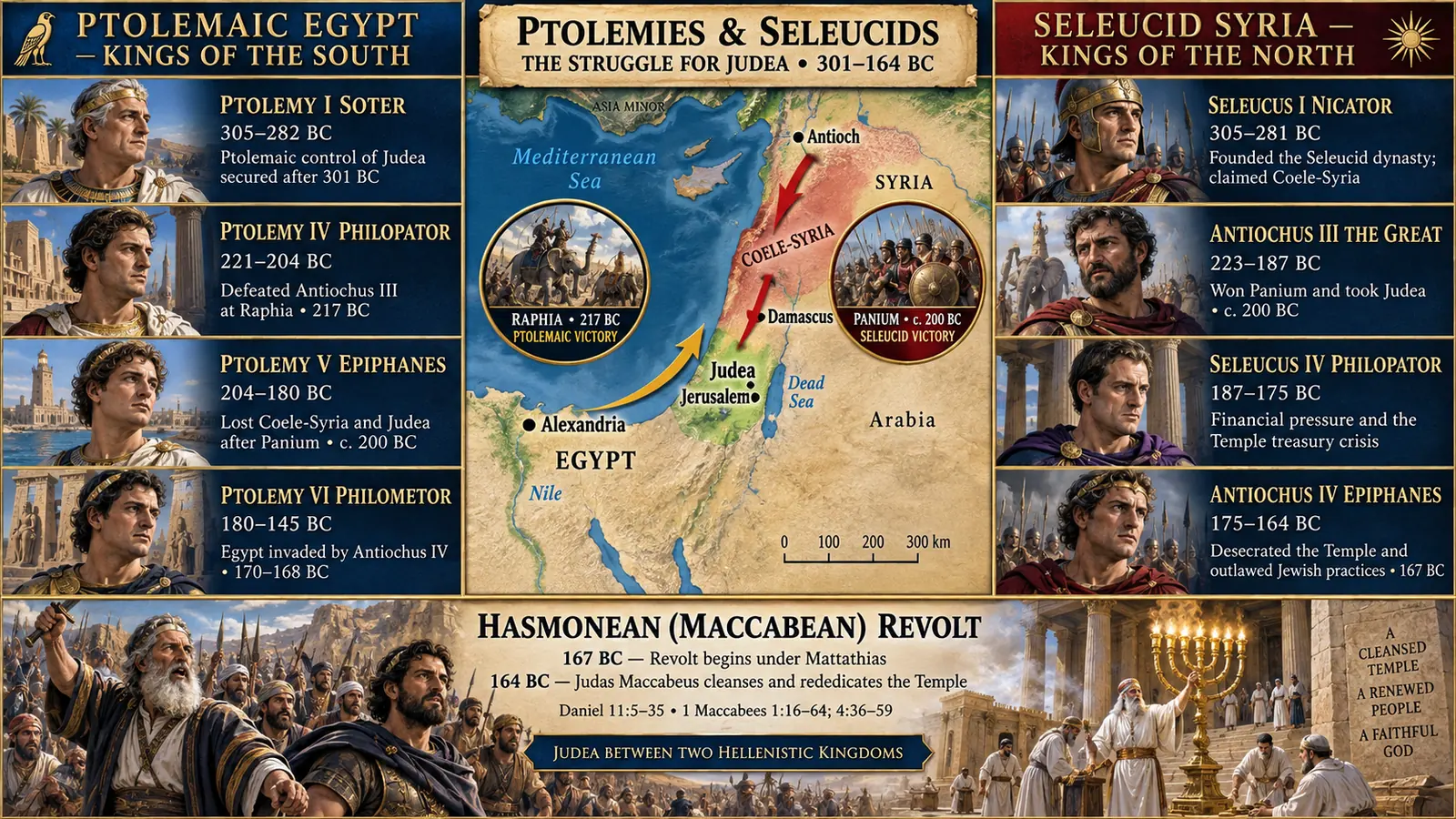
Alexander the Great took Tyre and Gaza in 332 BC, and Judea passed from Persian to Greek rule. After he died in 323 BC, his generals divided his empire. The Ptolemies of Egypt held Judea until the Seleucid king Antiochus III defeated them at Panium, about 200 BC. Josephus preserves a letter in which Antiochus III gives Jerusalem tax relief, support for the temple, and the right to live under its own laws.Arrian, Anabasis 2; Josephus, Antiquities 12.138–144
- Outside evidence
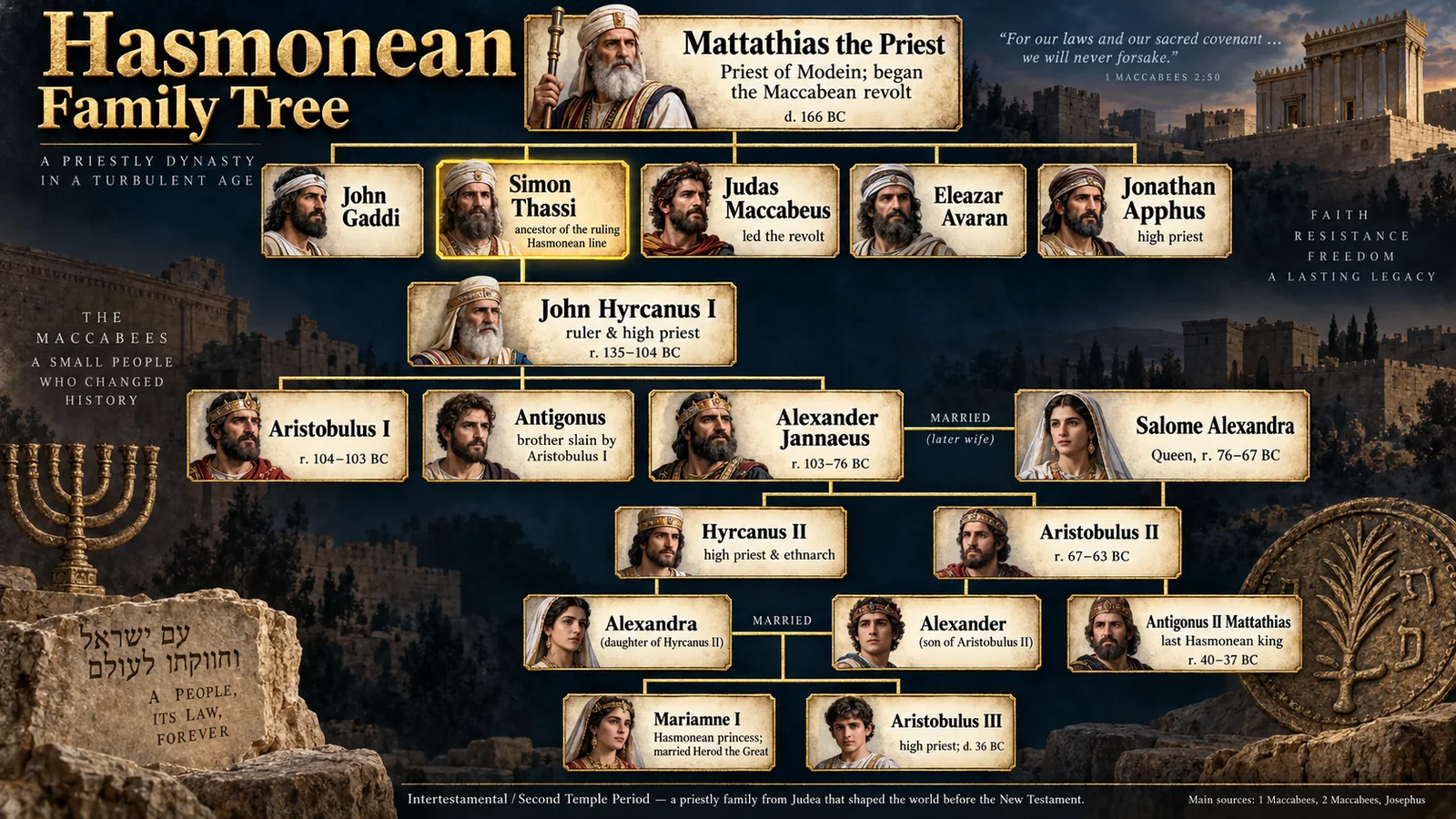
In December 167 BC, Antiochus IV set up a pagan cult object on the temple altar, which turned God’s altar to a foreign use. A priest named Mattathias and his sons, led by Judas Maccabeus, revolted. In 164 BC they cleansed and rededicated the temple and held an eight-day feast. Josephus says it came to be called “Lights.”1 Macc 1:54; 1 Macc 4:52; 2 Macc 10:1–8; Josephus, Antiquities 12.316–325
- Outside evidence
The family of Mattathias, called the Hasmoneans, ruled Judea for about a century. Under Simon, Judea was effectively independent (about 142 BC). Alexander Jannaeus (103–76 BC) is the first ruler whose coins carry the title “king.” Dates at each change of ruler vary by about a year in the sources.1 Macc 14:41; Josephus, Antiquities 13–14; Livius.org, “Hasmonaeans”
- Outside evidence
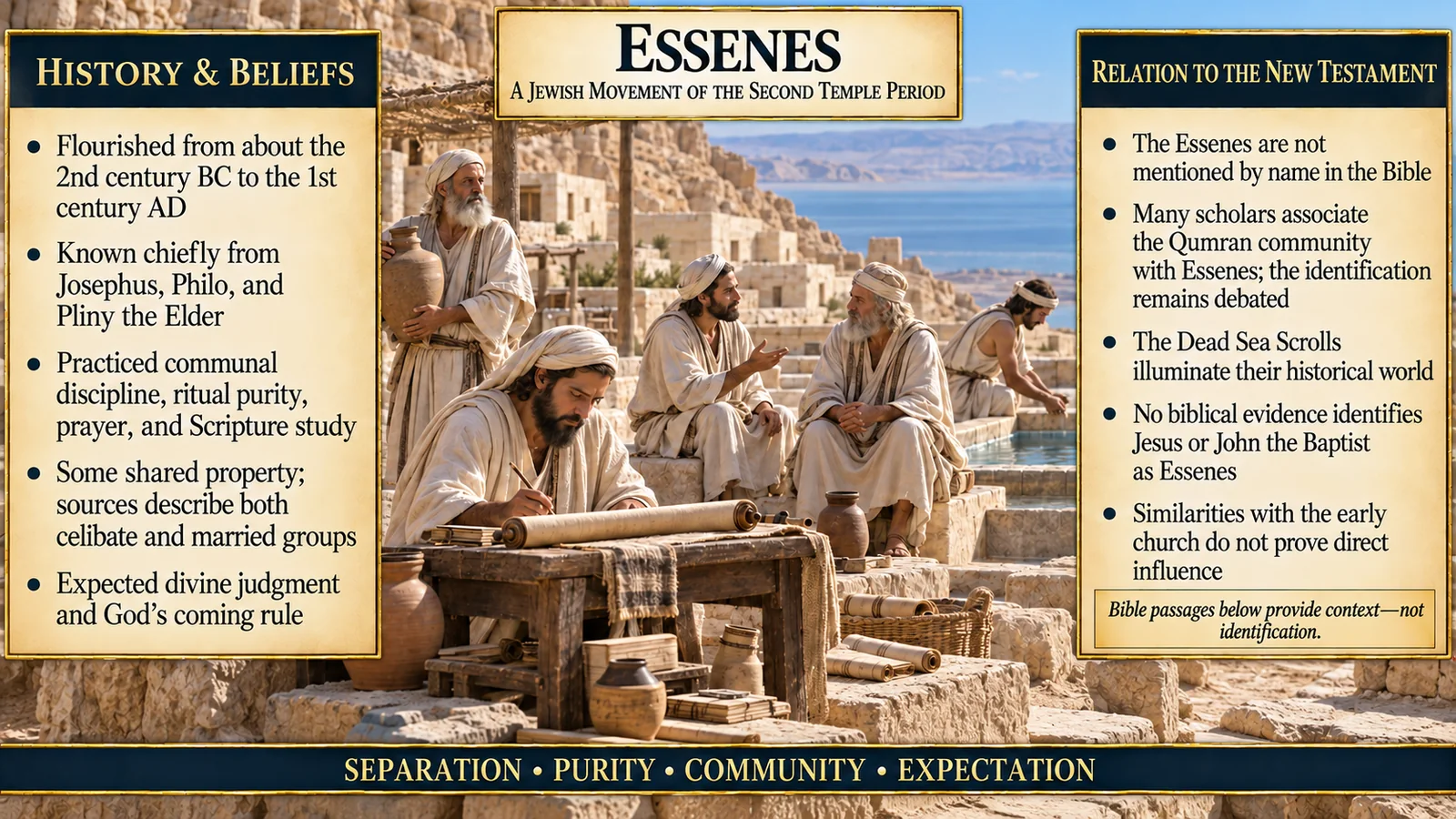
Josephus is the first to describe three Jewish schools, the Pharisees, Sadducees, and Essenes, and he places them in the time of Jonathan, in the mid-100s BC. He sorts them by how they understood fate and human choice. Philo and Pliny the Elder also describe the Essenes.Josephus, Antiquities 13.171–173; Josephus, Jewish War 2.119–161; Pliny, Natural History 5.73
- Outside evidence
In 63 BC the Roman general Pompey took Jerusalem after a civil war between two Hasmonean brothers. Josephus says about 12,000 Jews died. Pompey entered the sanctuary but left its treasures alone and restored Hyrcanus II as high priest. Josephus dates the event by the Roman consuls of that year.Josephus, Antiquities 14.65–73
- Outside evidence
Rome named Herod king in 40 BC, and he took Jerusalem in 37 BC. He began rebuilding the temple in the eighteenth year of his reign, about 20/19 BC. Josephus says the sanctuary took a year and a half and the courts and porches eight years. He reports the whole project finished only much later.Josephus, Antiquities 15.380; 15.420–421; 20.219
- Outside evidence
The Torah was translated into Greek in Alexandria, about 280–250 BC, and other books followed later. This is the Septuagint. The Letter of Aristeas tells the story of 72 translators working for King Ptolemy II, but it was written later and is not an eyewitness account.Letter of Aristeas; Prologue to Sirach; Tov, The Text-Critical Use of the Septuagint (3rd ed., 2015)
- Outside evidence
Catholic and Orthodox Bibles include 1 and 2 Maccabees as Scripture. Protestant Bibles do not. Either way, these books are still our main source for this period.Council of Trent, Session 4 (1546); Westminster Confession 1.3
- Debated
When was Daniel written? The book places itself in the exile, and this site follows that date. Many scholars date it, or at least chapters 7–12, to about 165 BC. Their main reason is that Daniel 11 follows events in close detail down to about 167 BC, so they read it as written during the crisis under Antiochus IV. Others hold the traditional date, pointing to the book’s own setting and to Jesus speaking of “Daniel the prophet.” This site uses the 500s BC as its working framework and presents the later date as a serious alternative.Dan 11:31; Matt 24:15; Collins, Daniel (Hermeneia, 1993); Steinmann, Daniel (Concordia, 2008)
- Debated
Was it really four hundred “silent” years? First Maccabees mentions waiting “till there should come a prophet” (Douay-Rheims), and Josephus says there was no “exact succession of prophets” after Artaxerxes. Some read that as prophecy ending. Others, such as John Levison, argue that these passages only say no prophet appeared at that moment. Either way, the period produced a great deal of writing.1 Macc 4:46; 1 Macc 9:27; 1 Macc 14:41; Josephus, Against Apion 1.41; Levison, NTS 43 (1997)
- Debated
Why did Antiochus IV attack Jewish worship? The older view is that he set out to ban the Jewish religion. Sylvie Honigman argues that taxes, a rivalry over the high priesthood, and a political crackdown came first. Both views agree that the temple was seized and the revolt was real.1 Macc 1; Honigman, Tales of High Priests and Taxes (2014)
- Debated
Who lived at Qumran? Many scholars hold that the community near the Dead Sea Scrolls caves was Essene. Others propose Sadducean priests, or argue that the site was a fortress, a villa, or a pottery works. The question is still open.Pliny, Natural History 5.73; Dead Sea Scrolls
- Debated
What were people hoping for? Many Jews hoped God would act, and some hoped for a king from David’s line. The Psalms of Solomon, written after Pompey, pray for one. Scholars agree the hopes varied. There was no single expected script.Psalms of Solomon 17; Neusner, Green, and Frerichs, eds., Judaisms and Their Messiahs (1987); Collins, The Scepter and the Star (2nd ed., 2010)
- Debated
When did Herod die? Most scholars say about 4 BC. A minority, including Andrew Steinmann, argue for 1 BC. The answer moves the date of Jesus’ birth, which the Gospels place before Herod’s death.Josephus, Antiquities 17.167; Matt 2:1
- Christian conclusion
Christians read Malachi’s promised messenger and “Elijah” as fulfilled in John the Baptist, who prepares the way for Jesus.Mal 3:1; Mal 4:5–6; Mark 1:2; Luke 1:17
- Christian conclusion
Christians read these centuries as God preparing “the fullness of the time” in which he sent his Son. That means a common language, a Greek Old Testament, a rebuilt temple, and a people waiting for God to keep his promises.Gal 4:4
What happened between the Testaments
Turn one page in your Bible, from Malachi to Matthew, and you skip about four hundred years.
In Malachi, Persia rules. The temple has been rebuilt, and the priests are going through the motions.
In Matthew, Rome rules. A king named Herod sits in Jerusalem. The temple has been rebuilt again, bigger. And there are people called Pharisees and Sadducees who never show up in the Old Testament at all.
The New Testament doesn’t stop to explain any of that. It assumes you already know it. This page fills the gap.
Scholars often call this the Second Temple period, which runs from the rebuilt temple (516 BC) to its destruction in AD 70. “Intertestamental” is a Christian label. It just means “between our two Testaments.” Both names are fine.
The dates here are approximate. The goal is not to settle every scholarly argument. It’s to give you a working map of how the story gets from one Testament to the other.
The powers: Persia, Greece, the Hasmoneans, Rome
Four powers run this stretch of history. Keep them in order and the rest falls into place.
Persia. The Old Testament closes under Persian rule, and it lasts for about another century.
Greece. In 332 BC Alexander the Great swept down the coast, took Tyre and Gaza, and Judea changed hands. He died in 323 BC, and his generals carved up his empire. For about a hundred years Judea belonged to the Ptolemies of Egypt. Then, about 200 BC, the Seleucid kings of Syria took it. At first that went well. Antiochus III gave Jerusalem tax relief and let it live by its own laws.
His son, Antiochus IV, did not. In 167 BC his forces desecrated the temple altar. Why he did it is still argued. Either way, a priest named Mattathias and his sons fought back. The best-known son, Judas, was nicknamed “the Maccabee.”
The Hasmoneans. The revolt worked. Mattathias’s family ruled Judea for about a century, and under Simon it was effectively independent. Later rulers took the title of king. Then two brothers went to war over the throne.
Rome. In 63 BC the Roman general Pompey settled that war by taking Jerusalem himself. From then on, Rome was in charge. In 37 BC Rome’s chosen king, Herod, took the city. That is the world of the Gospels.
The groups Jesus met: Pharisees, Sadducees, Essenes
The Gospels drop you into arguments between parties you’ve never been introduced to. This is where they come from.
Josephus first describes three Jewish schools in the mid-100s BC, during the Hasmonean years. Where they started before that is unclear.
He sorts them by a question that sounds abstract but wasn’t: how much of life is in God’s hands, and how much is in ours? The Pharisees said some of each. The Essenes said fate rules everything. The Sadducees said none of it is fate.
The New Testament gives you the difference that matters most in the Gospels. “For the Sadducees say that there is no resurrection, nor angel, nor spirit; but the Pharisees confess all of these” (Acts 23:8). That one line explains a lot of scenes.
The Essenes never appear in the New Testament. Many scholars think the community near the Dead Sea Scrolls was Essene. That’s a majority view, not a settled fact, and I’ll keep it labeled that way.
The Septuagint
Alexander’s conquests spread Greek across his world.
In Alexandria in Egypt, about 280–250 BC, the Torah was translated into Greek. The other books followed later. That translation is called the Septuagint.
You may hear the famous story of 72 translators working for an Egyptian king. That story comes from the Letter of Aristeas, which was written later. Treat it as legend, not as a report.
What isn’t legend is this. Centuries before the New Testament was written in Greek, Jews already had their Scriptures in Greek.
Was it silent?
You’ll hear these called the “four hundred silent years.” That’s half right.
No new book of prophecy from these years made it into the Protestant Old Testament. Even 1 Maccabees talks about waiting “till there should come a prophet” (Douay-Rheims). Josephus says there was no “exact succession of prophets” after the Persian king Artaxerxes.
But whether prophecy “stopped” is debated. Some scholars point out that those lines only say no prophet showed up at that moment.
And the period was anything but quiet. It gave us Ben Sira, 1 and 2 Maccabees, 1 Enoch, Jubilees, and the Dead Sea Scrolls. So it wasn’t a silence of history. It was a pause in new prophetic Scripture.
One quick note on canon. Catholic and Orthodox Bibles include 1 and 2 Maccabees. Protestant Bibles do not. Either way, those books are still our main source for these years.
It was also a time of hope. Some Jews hoped for a king from David’s line. The Psalms of Solomon, written after Pompey took Jerusalem, pray for one. But the hopes varied. There wasn’t one script everybody expected the Messiah to follow.
Hanukkah
After the Maccabees retook Jerusalem, they cleansed the temple and rededicated it in 164 BC, three years after it was desecrated. They celebrated for eight days. Josephus says the feast came to be called “Lights.”
Jews still keep it today as Hanukkah. John calls it the Feast of the Dedication.
And here’s the part most Christians miss. Jesus was in the temple for it. “It was the Feast of the Dedication at Jerusalem” (John 10:22). A festival born in these “silent” years shows up in the Gospel of John.
Herod and the temple
Herod was Rome’s choice. Rome named him king in 40 BC, and he took Jerusalem in 37 BC. He ruled until about 4 BC, though a minority of scholars argue for a few years later.
In about 20/19 BC Herod began rebuilding the temple. Josephus says the sanctuary took a year and a half and the courts and porches took eight years. He reports the whole project finished only much later.
That helps explain a line in John. When Jesus says “destroy this temple,” his opponents answer, “It took forty-six years to build this temple! Will you raise it up in three days?” (John 2:20). Count forward from about 20 BC and you land in the years of Jesus’ ministry.
This is the temple of the Gospels. When the disciples point out its buildings to Jesus, this is what they’re looking at.
Why it matters for the New Testament
Text, story, message, meaning. This page is mostly the first two. But it carries the other two.
The text of Malachi ends with a promise: a messenger to prepare the way, and Elijah before the day of the LORD. Then the story goes quiet on the page while empires rise and fall.
When it picks back up, the Gospels open with John the Baptist, and they read him as that messenger. The message is that God didn’t forget what he said through Malachi.
Paul puts the meaning in one sentence: “But when the fullness of the time came, God sent out his Son, born to a woman, born under the law” (Galatians 4:4). Christians read these centuries as the run-up to that moment. There was a common language, a Greek Bible, a rebuilt temple, and a people waiting.
Without this period, the New Testament reads like a story that starts in the middle. With it, you can see how one leads to the other.