Jerusalem
The city David made Israel’s capital and Solomon’s temple made its center of worship.
Region
- JudahTribal territoryUnited MonarchyDivided KingdomExileReturn & Restoration
Verses
Verses: 1 Kgs 14:21; 2 Sam 5:5; Ezra 5:1
Over time
- BenjaminTribal territorydebatedConquest & Settlement
Verses and notes
Joshua 18:28 lists Jerusalem among Benjamin’s towns, and Joshua 15:8 runs the Judah–Benjamin border right past it. Joshua 15:63 and Judges 1:8 tie it to Judah; Judges 1:21 ties it to Benjamin. Both readings are shown here; the texts do not settle it.
Verses: Josh 18:28; Josh 15:8; Josh 15:63; Judg 1:8; Judg 1:21
- JudeaDistrictThe Gospel & Jesus ChristThe Spread of Christianity
What the sources say, and how sure we are
- The text says
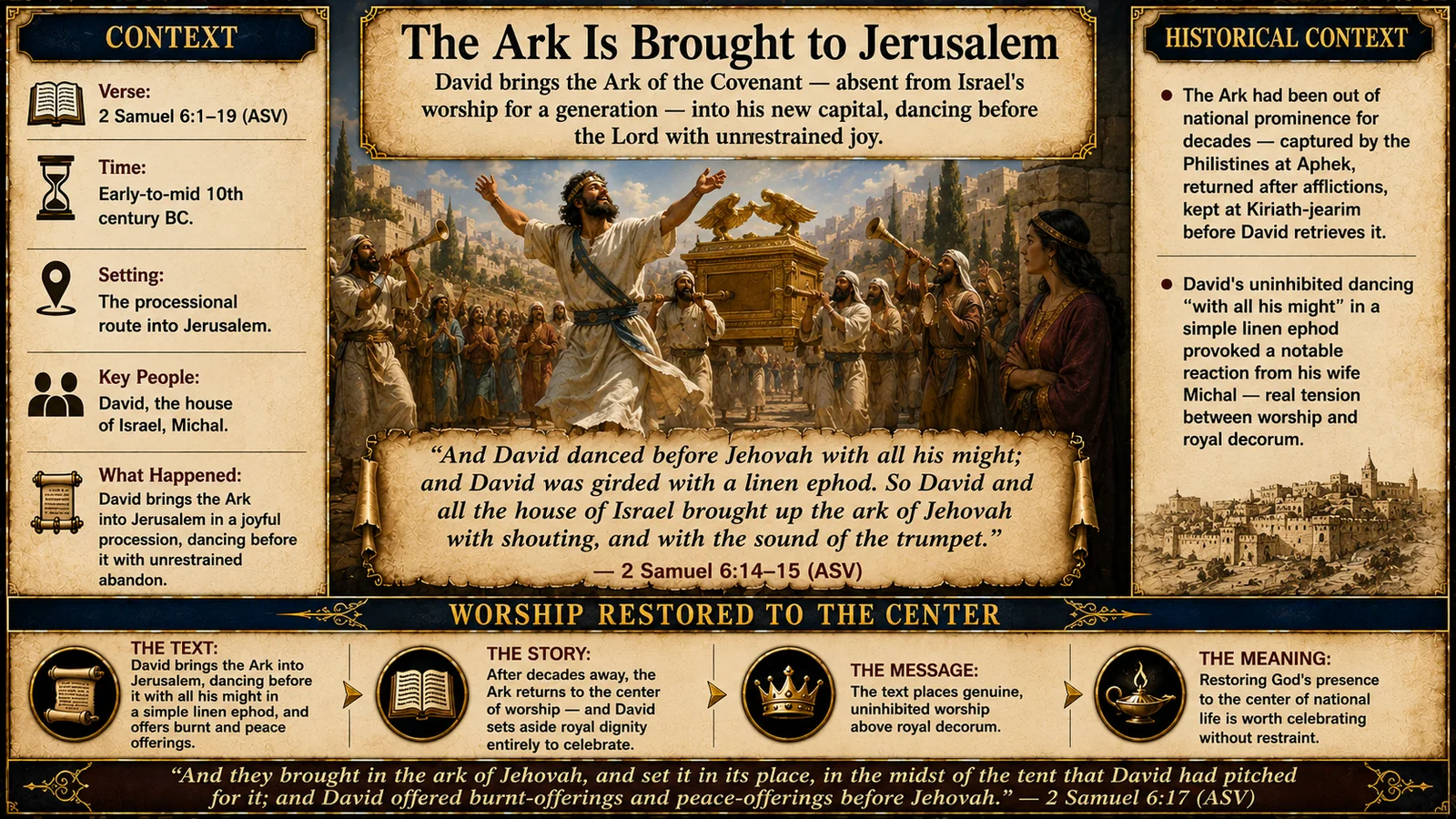
David captured the Jebusite stronghold and made it his capital. Solomon built the temple there.2 Sam 5:6–10; 1 Kgs 6–8
- Outside evidence
The Babylonian Chronicle records that Nebuchadnezzar captured “the city of Judah” in 597 BC, which matches 2 Kings 24:10–17.Babylonian Chronicle (ABC 5)
- Outside evidence
The Siloam Tunnel inscription, found in 1880, describes workers cutting a water tunnel. It is commonly linked with King Hezekiah’s work.2 Kgs 20:20
- Outside evidence
The first temple’s site on the Temple Mount cannot be excavated, so the temple is known from the Bible and later sources, not from excavation of the building itself.
- Debated
Archaeologists disagree about how large and important Jerusalem was in the time of David and Solomon (about 1000–930 BC). Some see a modest highland town, others a real regional capital. Buildings proposed as David’s palace are contested.
- Christian conclusion
Christians hold that Jesus was crucified and raised in Jerusalem, and Revelation 21 pictures a “new Jerusalem.”Luke 24:47; Rev 21
One city, many eras
Jerusalem appears in seven of the eleven eras: as David’s capital, the temple city of the kingdoms, the city destroyed in the exile and rebuilt after the return, the city Rome captured under Pompey in 63 BC, the setting of Jesus’s last week, and the starting point of the early church.